


You may also like
-
Kleine Welten II Poster
Wassily Kandinsky · 1922 · Rhythmic geometric art print with floating circles, sharp lines, and a bold black field
Poster from €9 · Framed from €16
Regular price From €6,00Regular price -
Kleine Welten IV Poster
Wassily Kandinsky · 1922 · Abstract art print of circles and angular lines with bright blue yellow green accents
Poster from €9 · Framed from €16
Regular price From €6,00Regular price -
Kleine Welten V Poster
Wassily Kandinsky · 1922 · Rhythmic geometric poster of circles and sharp lines against a deep black field
Poster from €9 · Framed from €16
Regular price From €6,00Regular price -
Violet Poster
Wassily Kandinsky · 1923 · Geometric abstract art print with violet, blue, and yellow shapes on pale ground
Poster from €9 · Framed from €16
Regular price From €6,00Regular price


-

"Very nice Posters. The quality is amazing and we received it very quickly !"
-

"A shop to visit absolutely. Huge selection of posters. We spent more than an hour there !"
-

"Perfect to find gift. Price are very good. An they can frame and pack it on site"
About the Artist
Wassily Kandinsky was a pioneering figure of early twentieth-century abstraction, celebrated for his ability to translate musical concepts into visual language. Working in Munich, Moscow, and later Germany, Kandinsky played a central role in shaping modern painting and left a lasting impact on both graphic design and fine art printmaking. His innovative approach continues to inspire artists and collectors alike.
Discover more from this influential modernist in our Wassily Kandinsky posters and prints collection.
The Artwork
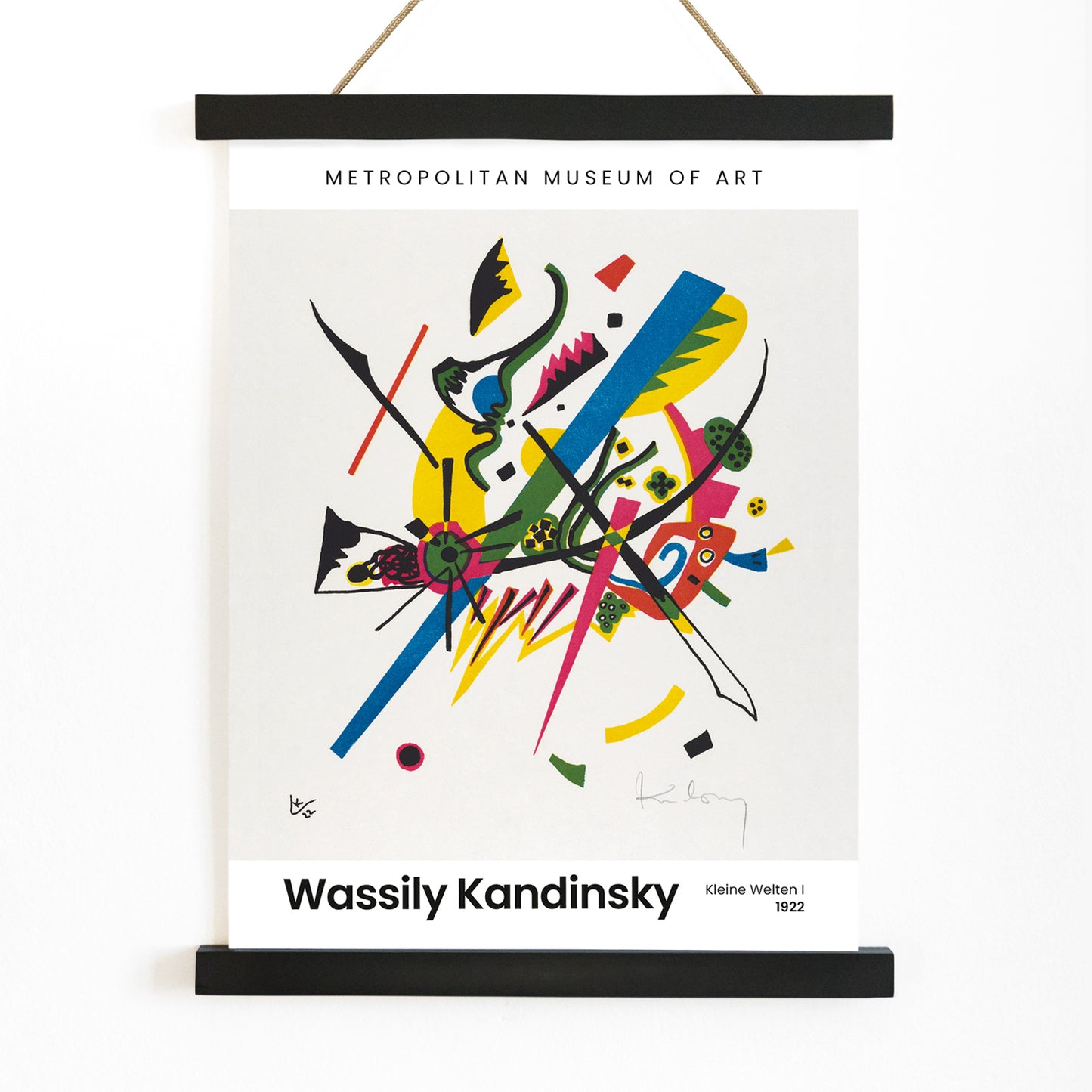
Kleine Welten I, created in 1922, marks a period when Kandinsky explored the possibilities of printmaking as a medium for pure abstraction. The title, meaning small worlds, reflects his fascination with constructing self-contained visual universes governed by their own internal logic. This work emerged during Kandinsky's tenure at the Bauhaus, where he encouraged experimentation and the idea that art could evoke emotion and thought without relying on recognizable subjects.
As part of the Kleine Welten series, this piece embodies the spirit of early modernism, inviting viewers to interpret its forms much like one might experience a piece of instrumental music—through rhythm, harmony, and dynamic interplay.
Style & Characteristics
Set against a crisp white background, the composition features floating geometric shapes, curved lines, and angular forms arranged with deliberate clarity. Black linework provides structure, while vivid accents of yellow, red, and blue energize the surface. The interplay of circles, lines, and sharp details creates a lively, rhythmic movement across the print, characteristic of Kandinsky's abstract style.
This is abstract wall art with a Bauhaus sensibility, making it a striking choice for those who appreciate modern, analytical, and playful design elements.
In Interior Design
Kleine Welten I serves as a compelling statement poster in living rooms, creative studios, or music spaces, especially where clean lines and curated decor are emphasized. Its bold geometry and color make it a natural fit for modern, mid-century, Scandinavian, or Bauhaus-inspired interiors, introducing a focused burst of energy without overwhelming the space.
For a cohesive gallery wall, pair it with other geometric or abstract works and finish with a simple mat and black frame to echo the artwork's strong linear elements.