


You may also like
-
Four Parts Poster
Wassily Kandinsky · 1932 · Abstract art print divided into four fields of crisp lines and shapes
Poster from €9 · Framed from €16
Regular price From €6,00Regular price -
Violet Poster
Wassily Kandinsky · 1923 · Geometric abstract art print with violet, blue, and yellow shapes on pale ground
Poster from €9 · Framed from €16
Regular price From €6,00Regular price -
Kleine Welten II Poster
Wassily Kandinsky · 1922 · Rhythmic geometric art print with floating circles, sharp lines, and a bold black field
Poster from €9 · Framed from €16
Regular price From €6,00Regular price -
Kleine Welten I Poster
Wassily Kandinsky · 1922 · Geometric abstract poster balancing circles, lines, and bright primary accents on white
Poster from €9 · Framed from €16
Regular price From €6,00Regular price


-

"Very nice Posters. The quality is amazing and we received it very quickly !"
-

"A shop to visit absolutely. Huge selection of posters. We spent more than an hour there !"
-

"Perfect to find gift. Price are very good. An they can frame and pack it on site"
About the Artist
Wassily Kandinsky was a pioneering figure of early modernism whose ideas helped define abstract art in Europe. After formative years with Der Blaue Reiter, he became a key teacher at the Bauhaus, where he explored how line, point, and shape could communicate like music.
This 1925 work sits in the heart of his Bauhaus period, when theory and practice were closely linked. It pairs beautifully with other pieces in our Wassily Kandinsky collection for a cohesive gallery wall of modern classics.
The Artwork
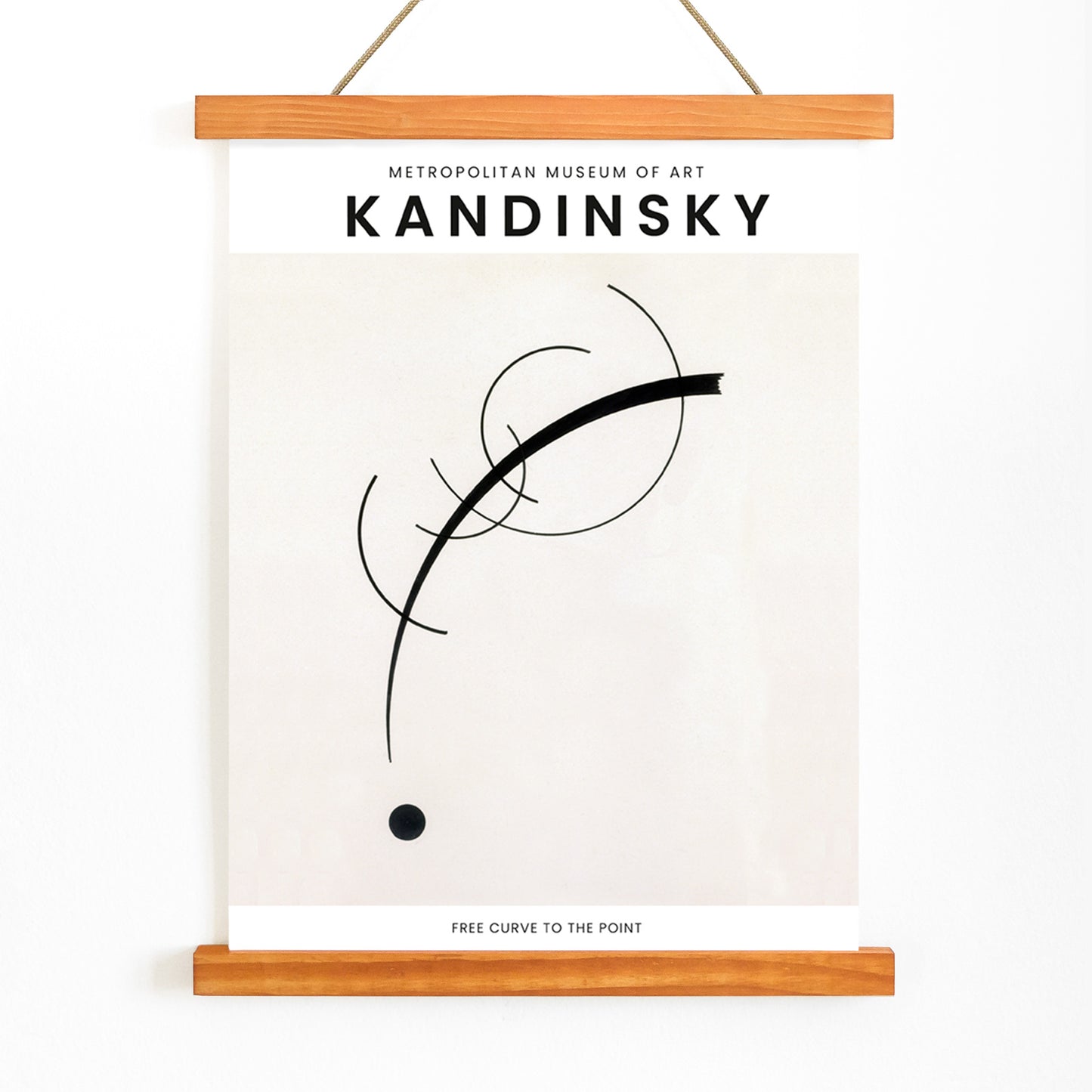
Free Curve to the Point reflects Kandinsky’s belief that pure visual elements can carry emotion without depicting the visible world. Created during a decade when artists were rebuilding visual language after World War I, this piece uses geometry as a universal vocabulary for harmony, tension, and release.
The title evokes a sense of movement and resolution: a curve journeys toward a point, reminiscent of a musical phrase reaching its conclusion. This work exemplifies Bauhaus-era experimentation, when abstraction became a tool for clarity, structure, and new perspectives on art.
Style & Characteristics
The composition features crisp black lines and shapes on a pale background, emphasizing stark contrast and precise arrangement. A sweeping curved line dominates the image, intersected by circles, triangles, and straight segments that punctuate the space with intentional rhythm.
The layout balances analytical structure with playful energy, offering both open space and tightly grouped forms. This black-and-white abstract art rewards close observation, as subtle shifts in angle and spacing create a sense of visual rhythm, echoing Kandinsky’s fascination with musical composition. For more graphic modernism, explore our abstract art prints and black and white selections.
In Interior Design
This geometric fine art print is well suited for minimalist interiors such as living rooms, hallways, or home offices, where its calm contrast can anchor a space without overwhelming it. Its monochrome palette pairs naturally with white walls, light wood, concrete, or charcoal textiles.
In contemporary settings, it complements Bauhaus-inspired furniture, chrome accents, and clean-lined shelving, while also adding structure to softer, Scandinavian rooms. Framed simply in black or natural wood, it becomes a refined focal point for those seeking modern abstract art with timeless balance.