


You may also like
-

Juniper Poster
Georg Dionysius Ehret · 1730 · Refined juniper botanical print with crisp needles and berries on warm paper
Poster from €9 · Framed from €16
-

A Group of Carnations Poster
Robert John Thornton · 1807 · Romantic botanical print of carnations with vivid reds, lush greens, and crisp whites
Poster from €9 · Framed from €16
-

Dahlias Poster
Willem Hekking Jr. · 1838 · Refined dahlia botanical print with layered petals and gentle greens on beige
Poster from €9 · Framed from €16
-

Stone vase with flowers Poster
Jean-Baptiste Monnoyer · 1690 · Baroque floral art print with a stone vase and lush garden bouquet
Poster from €9 · Framed from €16


-

"Very nice Posters. The quality is amazing and we received it very quickly !"
-

"A shop to visit absolutely. Huge selection of posters. We spent more than an hour there !"
-

"Perfect to find gift. Price are very good. An they can frame and pack it on site"
About the Artist
Georg Dionysius Ehret was one of the most influential botanical illustrators of the 18th century, renowned for his ability to combine scientific accuracy with a refined artistic sensibility. Born in Germany, Ehret worked across Europe and collaborated with leading botanists, contributing to the advancement of plant classification during a period of intense scientific discovery.
His works are prized today for their dual role as both scientific documentation and decorative art, making them a natural fit among other classic art wall art and elegant botanical prints in curated interiors.
The Artwork
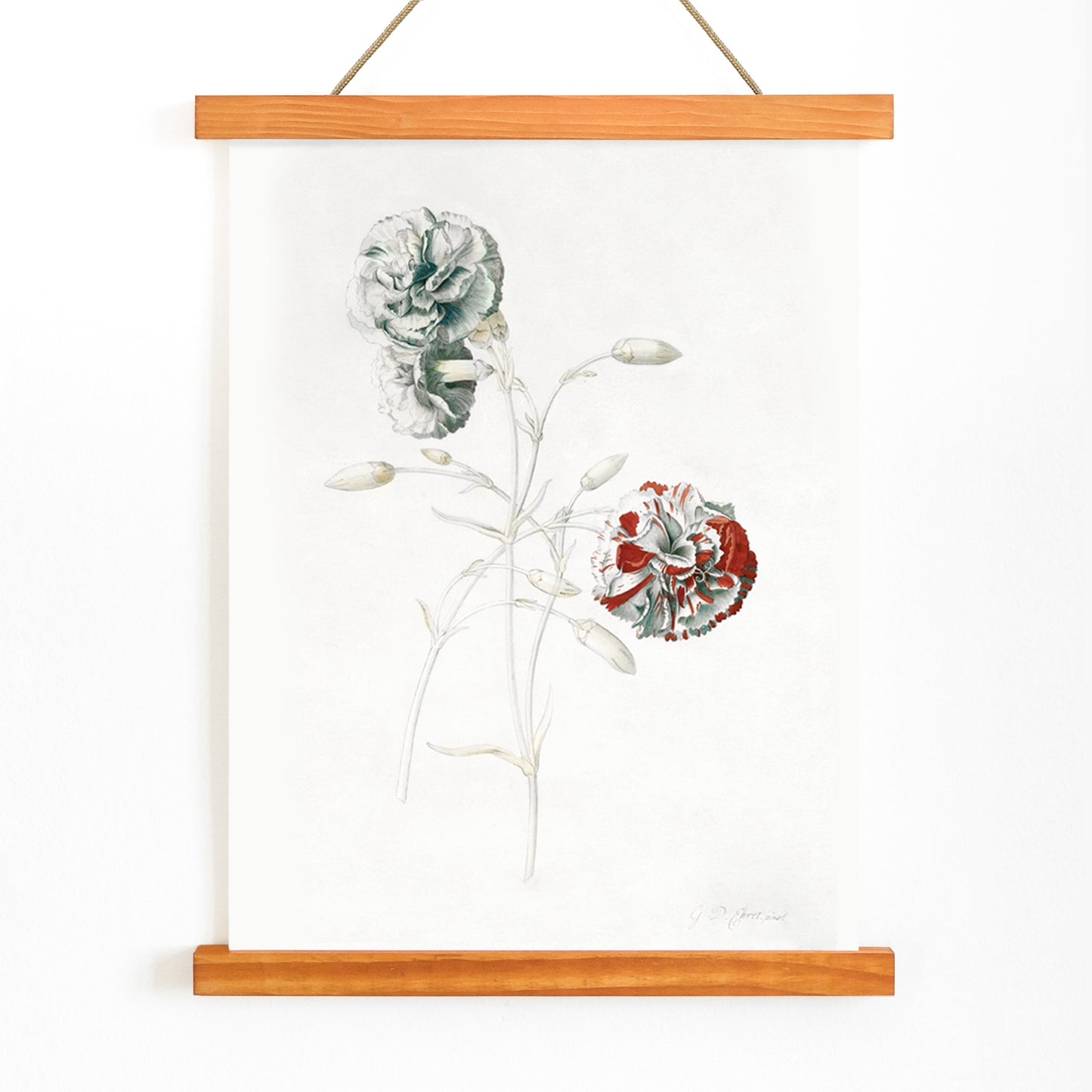
This carnation study was created during a time when horticultural pursuits were closely tied to status and intellectual curiosity. In the early 18th century, detailed botanical illustrations served as essential references for gardeners, collectors, and scholars, reflecting the era's fascination with cataloguing and cultivating rare plant varieties.
Ehret's depiction of the carnation not only documents a prized bloom but also embodies the spirit of exploration and appreciation for natural beauty that defined the Enlightenment. The artwork stands as a testament to the intersection of science, art, and cultural exchange, themes echoed in many science illustration prints.
Style & Characteristics
The composition centers a single carnation, rendered with precise linework and delicate shading that brings out the ruffled texture of the petals and the slender, arching stems. The flower is set against a creamy background, allowing its vivid red and soft white hues to stand out, while leafy greens offer a gentle contrast.
The restrained palette and balanced layout create a sense of clarity and calm, highlighting both the botanical structure and the flower's ornamental qualities. This approach exemplifies 18th century botanical art, where observation and aesthetics are harmoniously combined.
In Interior Design
This botanical print lends a subtle touch of heritage to kitchens, bedrooms, hallways, or reading nooks, and works especially well in interiors that favor natural textures and serene palettes. Its timeless elegance complements Scandinavian, English country, and transitional styles, while also softening minimalist spaces with organic detail.
Pair it with warm woods, linen textiles, and off-white walls, or echo the carnation's red tones with small decorative accents. For a refined presentation, display it with neutral mats and simple frames to create an airy, gallery-inspired arrangement.