


You may also like
-

Golf Club Patent 2 Poster
G.E. Barnhart · 1931 · Detailed golf club patent print featuring crisp diagrams and labeled engineering components
Poster from €9 · Framed from €16
-

Resilient Golf Club Head Patent Poster
L.A. Young · 1931 · Crisp vintage print of a resilient golf club head patent with annotated diagrams
Poster from €9 · Framed from €16
-

Golf Ball Patent Poster
R.B. Cavanagh · 1902 · Precise golf ball patent poster with sectional diagrams and crisp black linework
Poster from €9 · Framed from €16
-

Flute Patent Poster
D. Julliot · 1874 · Detailed flute patent vintage print with crisp schematics and archival beige paper
Poster from €9 · Framed from €16


-

"Very nice Posters. The quality is amazing and we received it very quickly !"
-

"A shop to visit absolutely. Huge selection of posters. We spent more than an hour there !"
-

"Perfect to find gift. Price are very good. An they can frame and pack it on site"
About the Artist
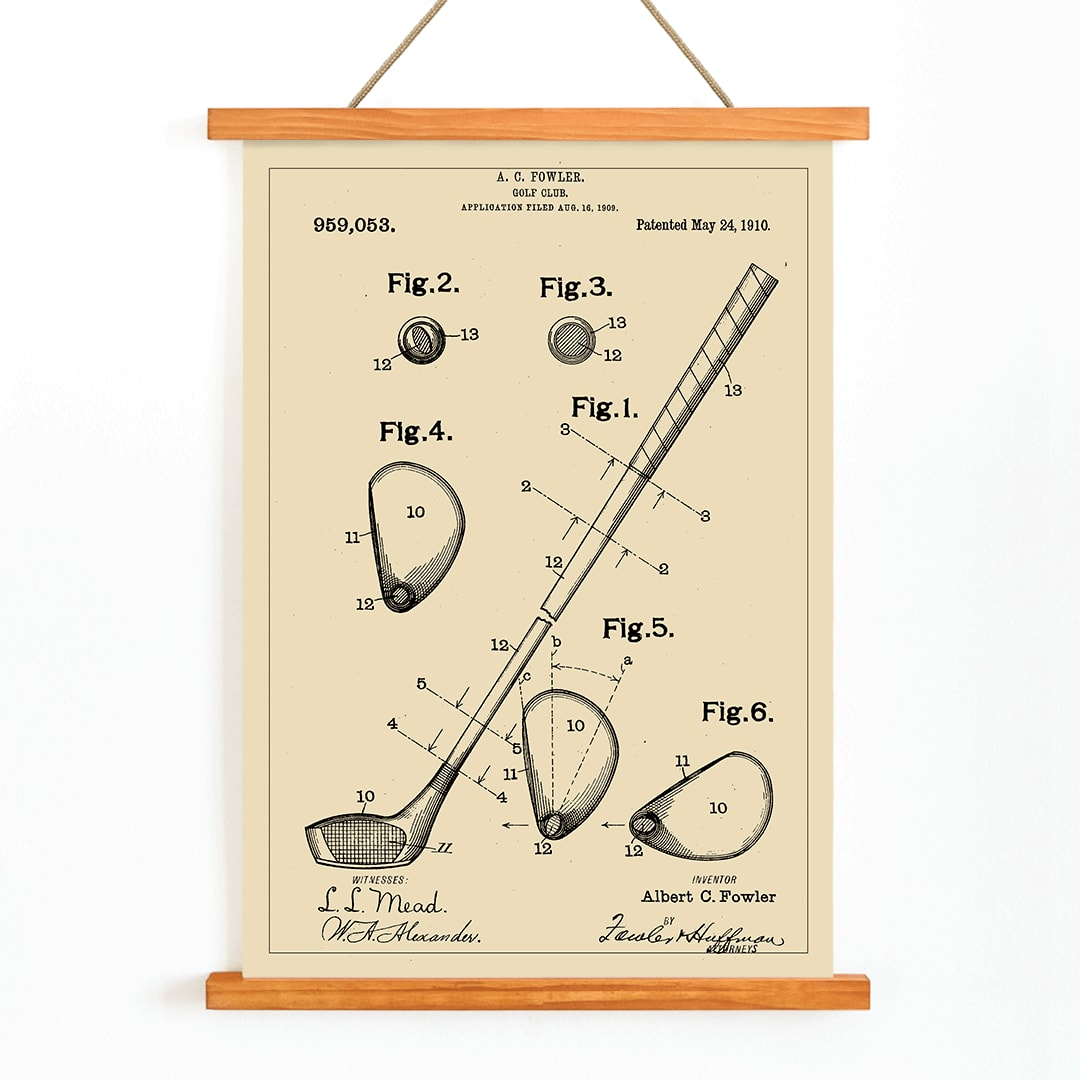
A.C. Fowler is listed as the inventor and draft author for this 1909 golf club patent, working within the tradition of technical illustration. Fowler’s contribution lies in translating mechanical innovation into precise visual language, ensuring that the patent’s details are preserved for both legal and historical record.
This document reflects a period when inventors and engineers were shaping the future of sports equipment, and patent drawings like this became part of the broader story of industrial progress and design evolution.
The Artwork
Created during a time when golf was solidifying its place as a modern sport, this patent sheet illustrates the drive to improve equipment through engineering ingenuity. Such documents were intended to clearly communicate new ideas to patent examiners and manufacturers, capturing the spirit of early 20th-century innovation.
The artwork embodies the belief that even recreational objects could benefit from technical refinement, making it a fascinating artifact for those interested in the intersection of sport, technology, and history. It stands as a testament to the era’s faith in progress and the value of meticulous documentation.
Style & Characteristics
The print features a vertical layout with multiple labeled diagrams of a golf club, each figure rendered in crisp black lines and accompanied by precise numbering. The composition is orderly and uncluttered, with a warm beige background that evokes the look of archival patent documents.
The restrained palette and technical style give the piece an understated authority, making it appealing to admirers of black and white wall art and science-inspired prints. The overall effect is clean, intelligent, and quietly sophisticated.
In Interior Design
This vintage print works well as golf-themed decor in a study, office, or den, where its technical elegance can spark conversation without overwhelming the space. It pairs especially well with leather furnishings, dark woods, and minimalist shelving, bridging classic sport culture and modern design sensibilities.
For a cohesive gallery wall, consider combining it with maps or other document-style pieces. Its warm tones also complement beige tone wall art, making it easy to integrate into neutral or Scandinavian-inspired interiors.