


You may also like
-

Orange Poster
Wassily Kandinsky · 1923 · Geometric orange poster balancing circles and sharp lines on an airy white ground
Poster from €9 · Framed from €16
-

Transmission Poster
Wassily Kandinsky · 1935 · Abstract geometric poster with playful circles, lines, and chromatic accents on warm ground
Poster from €9 · Framed from €16
-

Light Circle Poster
Wassily Kandinsky · 1922 · Geometric abstract poster with luminous circles and sharp angles on a deep dark ground
Poster from €9 · Framed from €16
-

Circles in a circle Poster
Wassily Kandinsky · 1923 · Radiant abstract poster of layered circles floating on a deep black field
Poster from €9 · Framed from €16


-

"Very nice Posters. The quality is amazing and we received it very quickly !"
-

"A shop to visit absolutely. Huge selection of posters. We spent more than an hour there !"
-

"Perfect to find gift. Price are very good. An they can frame and pack it on site"
About the Artist
Wassily Kandinsky was a pioneering figure in early abstract art, renowned for exploring painting as a language of rhythm, harmony, and inner experience. After his formative years with the Blue Rider group, he became a leading teacher at the Bauhaus, where his theories on color and geometry helped shape the direction of modern art.
If you appreciate modern classics, discover our Wassily Kandinsky collection and explore the wider world of Bauhaus posters for design-driven art with historical resonance.
The Artwork
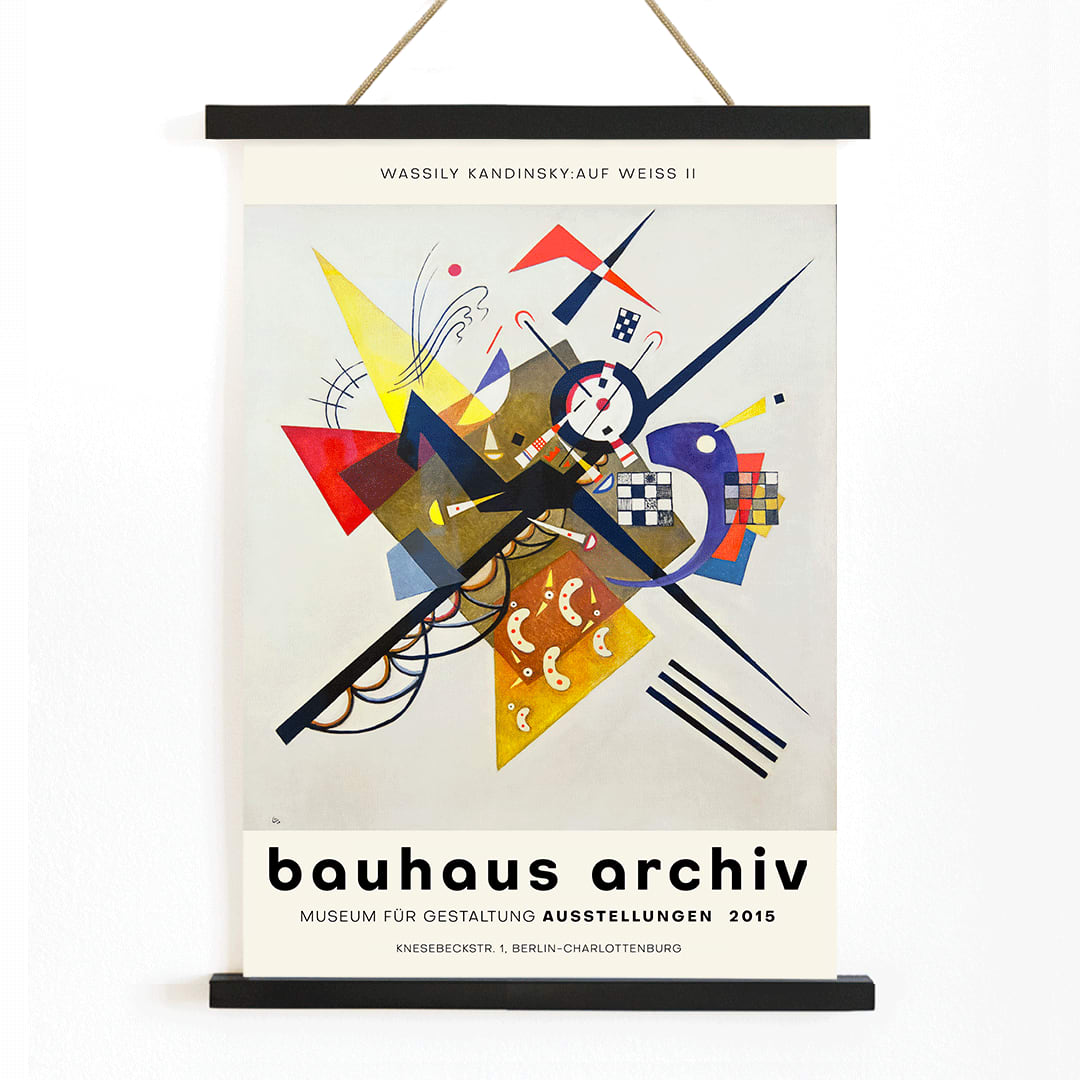
Created in 1923, Auf Weiss II reflects Kandinsky's search for harmony between structured order and creative intuition during his Bauhaus period. Rather than depicting a specific subject, the work was intended as a visual composition—an orchestration of forms and colors that evoke the sensation of music and movement.
Presented in Bauhaus exhibitions, pieces like this challenged traditional expectations of art by prioritizing universal principles of abstraction. This print embodies a moment when artists sought to redefine visual language for a new era, making it a significant example of geometric abstraction in the early twentieth century.
Style & Characteristics
The composition unfolds across a luminous white background, where crisp black lines, intersecting angles, and geometric shapes create a sense of dynamic balance. Circles, rectangles, and diagonal elements interact with precision, while accents of red, yellow, and blue add rhythmic highlights throughout the design.
The overall effect is energetic yet controlled, with a clarity and order that are hallmarks of Bauhaus aesthetics. The interplay of primary colors and sharp graphic forms gives the image a timeless quality, bridging vintage printmaking and modern abstract art.
In Interior Design
This geometric abstract poster serves as a striking focal point in contemporary interiors, especially in living rooms, creative studios, or workspaces seeking visual interest without representational imagery. It pairs well with minimalist decor, black or light wood frames, and neutral walls for a clean Bauhaus-inspired look.
For a cohesive effect, echo the primary color accents with select textiles or accessories, or display alongside other abstract wall art. Its bold composition appeals to design enthusiasts, architects, and anyone curating a modern, artful home environment.