


You may also like
-

Light Circle Poster
Wassily Kandinsky · 1922 · Geometric abstract poster with luminous circles and sharp angles on a deep dark ground
Poster from €9 · Framed from €16
-

Auf Weiss II Poster
Wassily Kandinsky · 1923 · Dynamic geometric abstract poster on white with primary colors and crisp black lines
Poster from €9 · Framed from €16
-

Orange Poster
Wassily Kandinsky · 1923 · Geometric orange poster balancing circles and sharp lines on an airy white ground
Poster from €9 · Framed from €16
-

Heavy Red Poster
Wassily Kandinsky · 1924 · Dynamic abstract poster centered on a heavy red block with crisp geometric accents
Poster from €9 · Framed from €16


-

"Very nice Posters. The quality is amazing and we received it very quickly !"
-

"A shop to visit absolutely. Huge selection of posters. We spent more than an hour there !"
-

"Perfect to find gift. Price are very good. An they can frame and pack it on site"
About the Artist
Wassily Kandinsky was a pioneering figure in abstract art, renowned for transforming color and geometry into expressive tools that transcended traditional representation. By the early 1920s, he was deeply involved with the Bauhaus movement, where he explored the relationship between form, color, and spiritual meaning in art.
This artwork is featured in our Wassily Kandinsky collection and is also part of our wider selection of abstract wall art, appealing to admirers of modernist innovation.
The Artwork
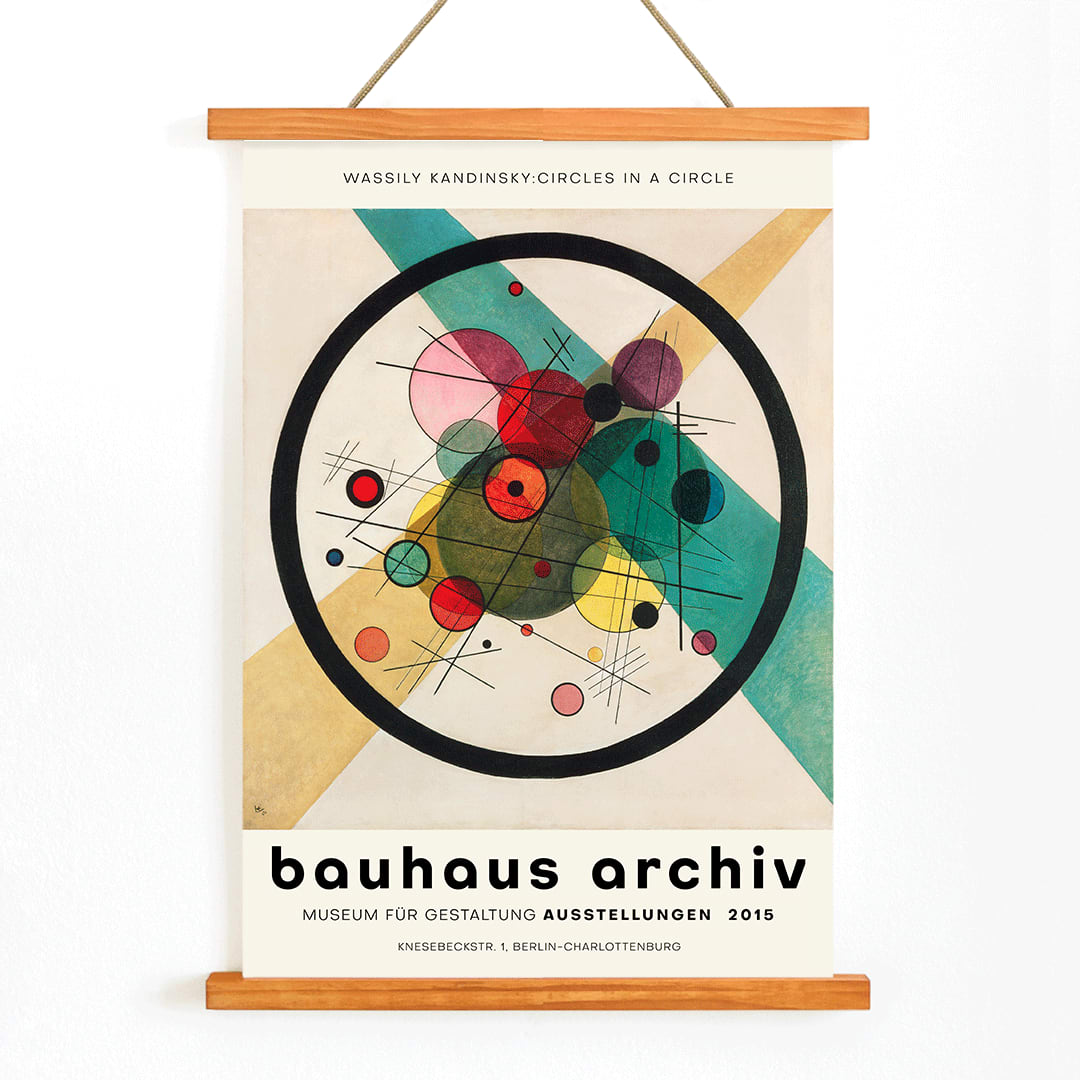
Created in 1923, Circles in a Circle marks a pivotal moment in Kandinsky's geometric period, when he sought to develop a universal visual language. Rather than depicting recognizable subjects, Kandinsky arranged circles and intersecting lines to evoke harmony, movement, and emotional resonance. This approach reflected a broader search among European artists for new ways to communicate ideas and feelings through abstraction, without relying on narrative or figuration.
The work embodies the modernist belief that abstract forms could express both intellectual structure and inner experience, making it a significant example of early twentieth-century artistic experimentation.
Style & Characteristics
The composition centers on a large, precise circle set against a deep black background, enclosing a constellation of smaller circles in vivid hues. Bright reds, greens, yellows, and pinks punctuate the interior, while overlapping shapes create a sense of depth and dynamic interaction. The crisp, clean edges and carefully balanced arrangement lend the piece a sense of clarity and optimism.
Despite its geometric precision, the artwork conveys a musical, almost playful rhythm, as if the circles are in motion within their boundary. This abstract poster stands out for its bold contrasts and harmonious palette, making it a lasting favorite among those drawn to geometric modernist art prints.
In Interior Design
This striking wall art serves as a sophisticated focal point in living rooms, offices, or hallways, especially where a touch of modern energy is desired. The black background contrasts beautifully with white or neutral walls, while the saturated colors can be echoed in decorative accents such as cushions or ceramics.
It pairs well with modern, Scandinavian, or mid-century interiors, and complements other Bauhaus posters in a curated gallery wall. A simple frame can highlight the geometry and maintain a clean, intentional atmosphere.