


You may also like
-

Sperm whale Poster
John Karst · 1880 · Detailed sperm whale print with classic engraving linework and calm coastal atmosphere
Poster from €9 · Framed from €16
-

Humpback whale and Minke whale Poster
Charles Melville Scammon · 1872 · Scholarly whale vintage print showing humpback and minke profiles with understated grey tones
Poster from €9 · Framed from €16
-

Attack Of the Cachalot Poster
Thomas Beale · 1839 · Dramatic maritime vintage print of a cachalot attack with stark black-and-grey contrast
Poster from €9 · Framed from €16
-

The anatomy of the horse Poster
George Stubbs · 1853 · Striking horse anatomy scientific print in crisp monochrome with labeled studies
Poster from €9 · Framed from €16


-

"Very nice Posters. The quality is amazing and we received it very quickly !"
-

"A shop to visit absolutely. Huge selection of posters. We spent more than an hour there !"
-

"Perfect to find gift. Price are very good. An they can frame and pack it on site"
About the Artist
George Johann Scharf was an 18th-century draftsman and engraver who contributed to the flourishing field of Enlightenment-era scientific illustration. Working at a time when natural history was rapidly evolving, Scharf’s engravings helped bridge the gap between artistic skill and scientific inquiry, making complex subjects accessible to a wider audience.
His works, such as this whale study, were intended for educational publications and collections, serving both scholars and curious laypeople. Scharf’s commitment to accuracy and clarity reflects the intellectual climate of his time, when detailed visual documentation became central to the study of the natural world. For those interested in the intersection of art and science, his legacy endures in the tradition of science wall art and the preservation of early zoological knowledge.
The Artwork
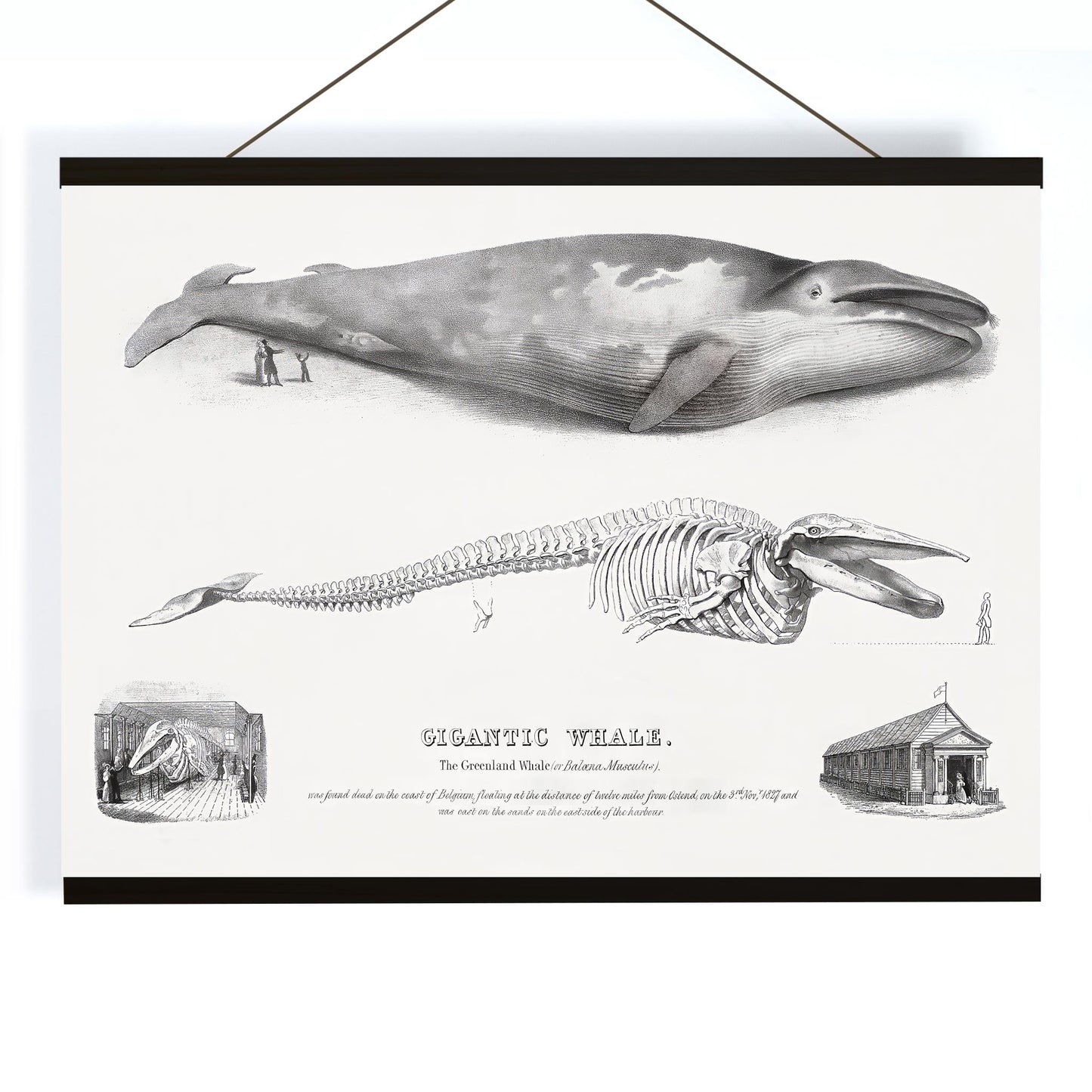
Created in 1758, this engraving captures a pivotal era in European natural history, when researchers were shifting from myth to method in their understanding of marine life. Whales, once the stuff of legend, became subjects of rigorous study, with artists and scientists collaborating to document their anatomy and scale.
This print exemplifies the Enlightenment’s drive to classify and comprehend the natural world. By presenting both the external form and internal skeleton of the whale, the artwork transforms maritime wonder into scientific evidence, echoing the spirit of early encyclopedic projects. It remains a compelling artifact for admirers of sea and ocean wall art and vintage scientific illustration.
Style & Characteristics
The composition features a precise side profile of the whale, paired with a detailed skeletal diagram below. Scharf’s meticulous linework and subtle shading emphasize anatomical accuracy, while the absence of extraneous detail keeps the focus on structure and proportion.
The restrained palette of black, white, and grey underscores the engraving’s archival quality. Ample negative space lends the piece a sense of calm and clarity, making it especially appealing to those who appreciate black and white prints with a scholarly, understated elegance.
In Interior Design
This scientific whale print introduces a sense of intellectual curiosity and quiet grandeur to interiors. Its horizontal format is ideal for display above desks, consoles, or as part of a gallery wall in studies, libraries, or living spaces.
It pairs beautifully with minimalist decor, natural wood accents, and neutral tones, or can be framed in darker wood for a more traditional, academic look. The print resonates with ocean enthusiasts, collectors of vintage engravings, and anyone drawn to the timeless appeal of scientific illustration.